Sugar Charlie radar
The Good ShepherdSugar Charlie radar is Keeling’s principal electronic aid to detecting danger at sea, but its value is inseparable from its defects. It can bring a U-boat into view before the ship can see her, while offering measurements too uncertain to settle how the crew should act. The radar extends the watch; it does not remove the need for judgment, steady reporting, and other forms of search.
Equipment and surveillance
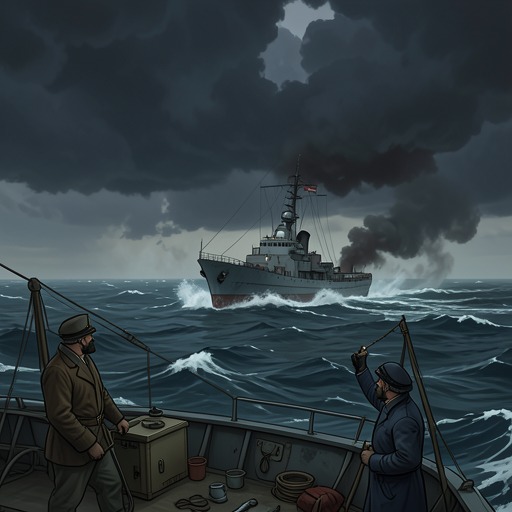
The radar’s rotating antenna is described as a bed-spring turning above Keeling’s mast. In rough weather, the ship’s rolling and pitching make the mast trace cones through the air, while the antenna continues its methodical revolutions. The equipment is part of an arduous, layered system of observation rather than a substitute for it. Seven lookouts scan assigned sectors through binoculars, pausing every few seconds to wipe away spray. Their watch must be constant: a U-boat may show only a foot or two of periscope, and for no more than half a minute. A brief sighting or reported torpedo wake could alter the fate of the convoy, or at least give Keeling a chance to save herself.
That human watch matters particularly because the radar is poor. During an approach toward a small, low target, Charlie Cole reports that it is dead ahead, but the image is not clear. Krause has heard of Sugar George, a newer radar he has never seen, and wishes Keeling had been equipped with one. The comparison gives the existing instrument a precise limitation: it can produce a contact, but its screen does not provide the definition its operators need.
Contact and uncertain readings
The radar nevertheless gives Krause grounds to treat the contact as a U-boat and to bring Keeling rushing toward it at twenty-two knots. Charlie reports a bearing of 093, then 093 and a half, with a range of fourteen miles. Over one minute and sixteen seconds the range closes by a mile. The changing numbers suggest that the submarine is approaching on a nearly reciprocal course. They turn the radar screen into a basis for tactical calculation, but not into certainty: Krause weighs the possibility of firing the Five-Inch Naval Guns against the risk of wasting a two-shell salvo when only two guns can bear ahead. With heavy seas, rapidly changing range, and a radar that may not be accurately lined up, he holds fire, hoping to close until the enemy is visible at a more favorable distance.
Later, another report exposes the same instability at a different stage of contact. Charlie calls the screen fuzzy and says it is jumping; he can give only an approximate bearing, first 209 and then 210, while reporting a range of 10,400. The numbers are useful enough to keep the pursuit informed, but their imprecision leaves the captain working from a moving estimate rather than a settled position. The equipment’s weakness is not that it reports nothing. It is that each report arrives accompanied by a measure of doubt.
Adjustment and operational limits
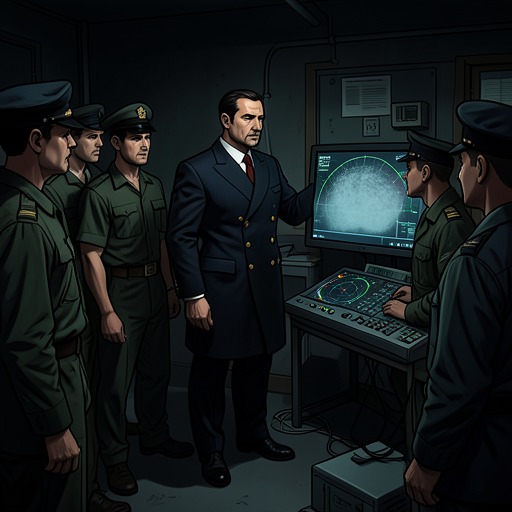
Krause summons Lieutenant Rudel to the chartroom to see whether he can improve the radar’s definition. Rudel says he can try to line it up better, but does not believe he can improve it much, if at all. When Krause presses him, Rudel points out that he submitted a written report on the problem four days earlier. The exchange reveals both a technical defect and an earlier warning that has not produced a repair before the present operation.
Rudel estimates that adjustment might take two hours and gives no guarantee of results. Krause leaves the equipment as it is: a misaligned radar is better than no radar, and there is too much else to do. The choice is not a claim that the instrument is satisfactory; it is a decision made under pressure, in which a possible improvement must be weighed against time and the value of retaining even imperfect contact information.
The instrument within the ship
The radar’s limits belong to a wider problem of maintaining readiness without exhausting the crew. Keeling is already in Condition Two, with battle stations largely manned and watertight integrity maintained. Calling general quarters would bring every man to his post, interrupt ordinary shipboard work, and leave men hungry and fatigued; it could not be sustained for long. Krause also knows that repeated demands without an obvious reason can make men slack in their duties. The radar’s uncertain readings therefore feed into a command system that must preserve attention as well as gather information.
The ship has new weapons and instruments, but the additional personnel needed to man them have strained its living space, and Keeling lacks enough trained ratings to sustain three watches in Condition Two. Krause divides the company into four sections and establishes a watch-and-watch routine, while trying to give the crew as much rest as the situation permits. In this setting, Sugar Charlie radar is neither a technological guarantee nor an isolated piece of machinery. It is one fallible component in a ship whose safety depends on equipment, trained interpretation, lookouts, communication, and the captain’s decisions about when the available information is sufficient to act.